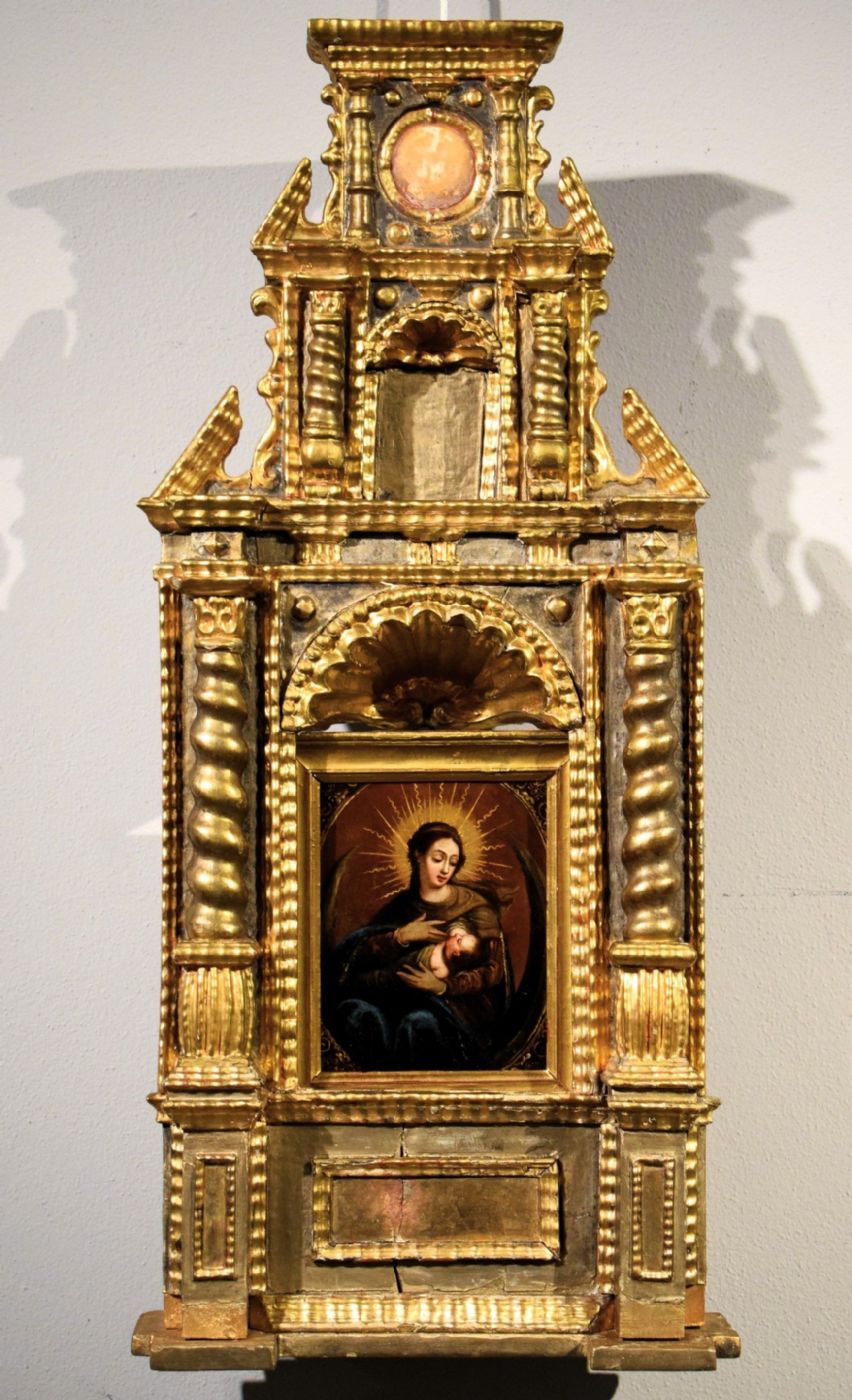
"Virgin of the Milk" (Virgo Lactans)
Oil on copper with gold highlights
Venetian Master
Early 17th century
Copper 14x18 cm
Original frame 18x22 cm
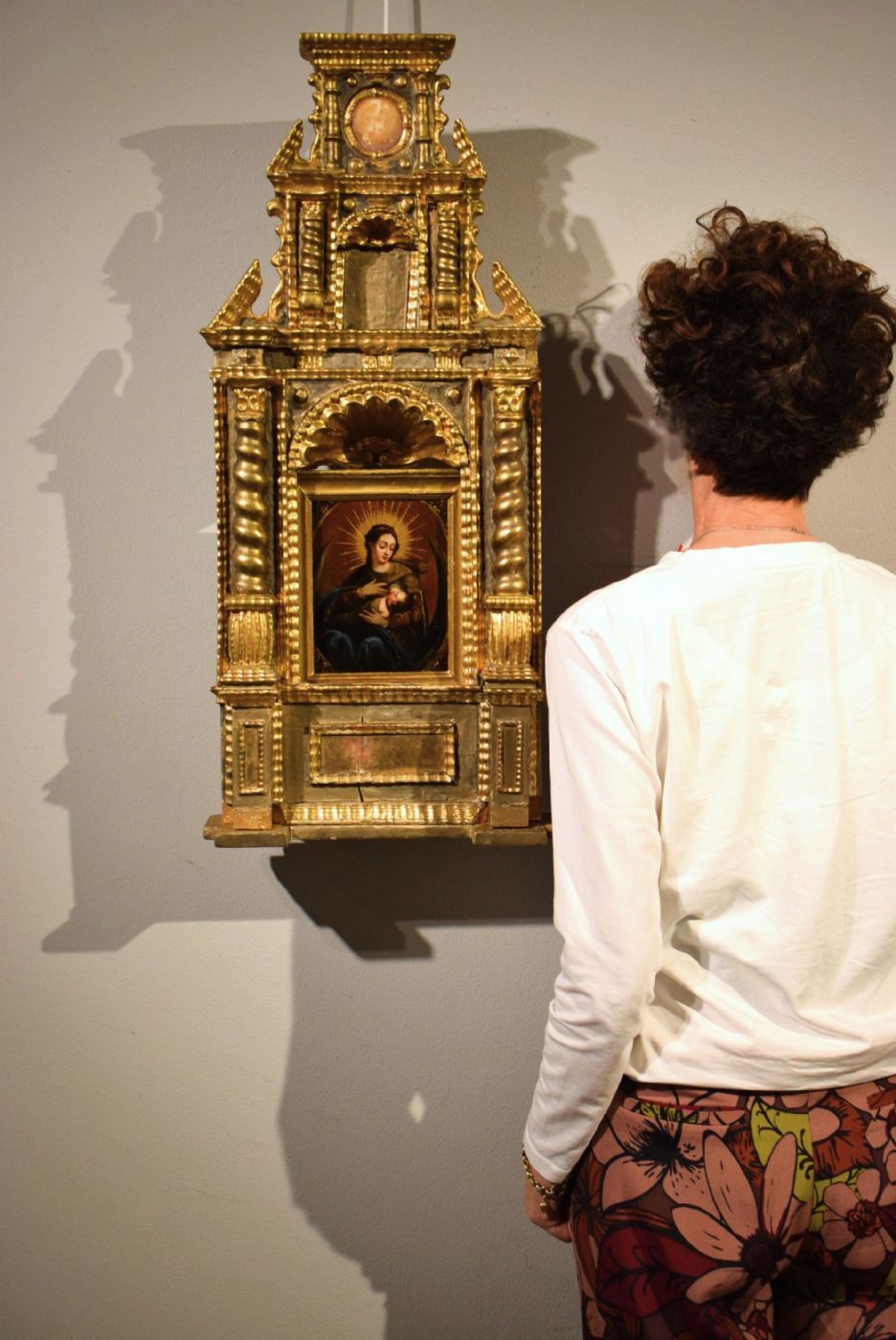
Architectural frame 40 x 70 cm
The painting is in excellent condition.
All details of the work at:
https://www.antichitaischia.it/it/prodotto/-vergine-del-latte--olio-su-rame
This small jewel painted in oil on copper, executed with great finesse, depicts the Virgin holding the Child in her arms and offering him her breast to nurse.
The child's profile face is turned upwards, meeting the gaze of the Mother who lowers her eyes in a tender maternal contact.
It is a particularly sought-after subject, of great charm, and the image is very pleasing.
The author is a 17th-century Venetian artist influenced by Flemish painting.
The copper plate, including the thin original frame, has been inserted into a magnificent shrine of a markedly architectural design, creating the effect of a splendid miniature altarpiece.
In addition to highlighting and giving importance to the painting, this rare gilded and silvered wooden altar is a significant added value, perfectly integrating into a fusion of two Venetian works of art from the same period.
The Virgin of the Milk, in Latin "Virgo Lactans", is a very significant Christian iconography in ancient painting and of great interest to any art collector. It falls within the so-called "Marian iconography", that is, the one that encompasses all sacred representations featuring the Virgin Mary as the protagonist.
Originating from very ancient times, from Eastern culture and also included in the Orthodox sphere, the representation of the Madonna nursing the Child has undergone numerous variations over the centuries, acquiring different meanings depending on the period and the culture of the places of origin.
It was precisely in the West that the Madonna del Latte underwent a significant modification, abandoning stylized representations to embrace greater naturalness of figures and poses. The figure is no longer depicted frontally and hierarchically, and an affectionate exchange of glances is established with the Child, just as in the work in question.
The Council of Trent, which began in 1543, with the decree: "De invocatione, veneratione, et reliquiis sanctorum et sacris imaginibus" defined the Church's position regarding devotional iconographies.
Among the aims of this decree was to avoid images of a sensual nature or perceived as such by the morality of the time.
The Tridentine Catholic Reformation listed among these inappropriate images, which could mislead the faithful, representations of Mary with exposed breasts as they were accused of distracting the faithful from prayer. Bishops were tasked with evaluating sacred images and deciding whether they should be retouched or removed. In the diocese of Milan, Carlo Borromeo in particular found such representations, widespread in Brianza, inappropriate, arranging in many cases to cover them with repaints. Churches dedicated to the "Madonna del Latte" had to change their name.