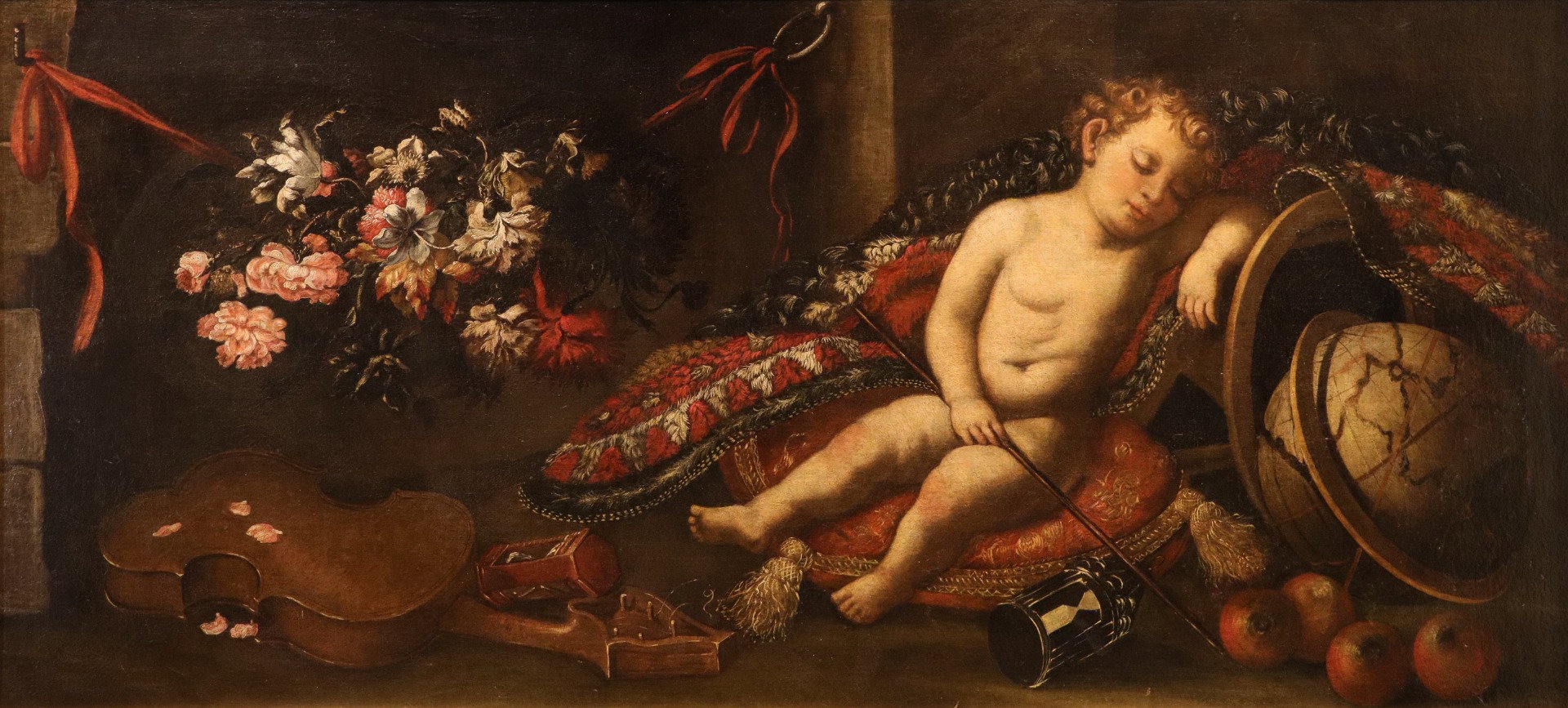
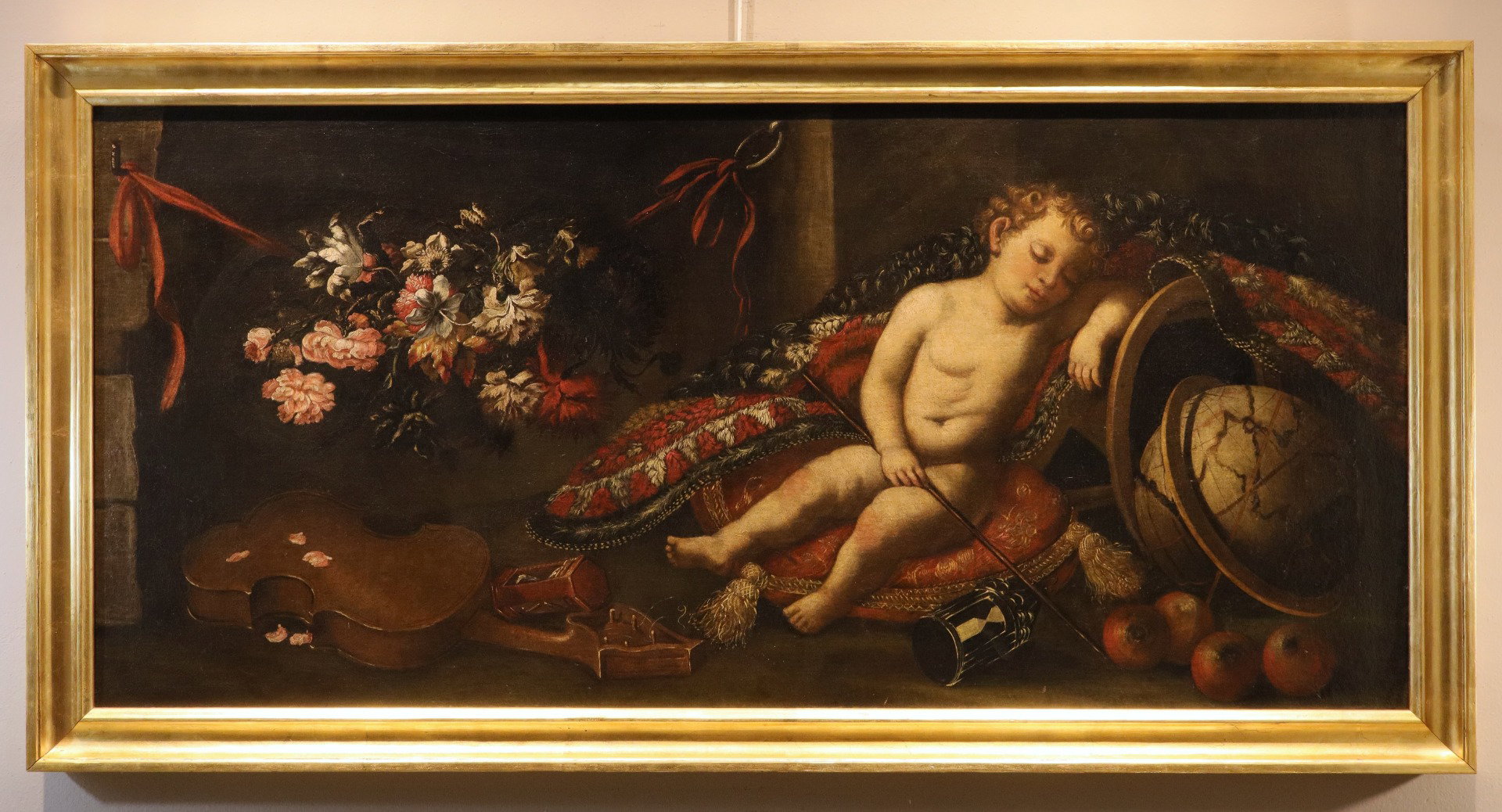
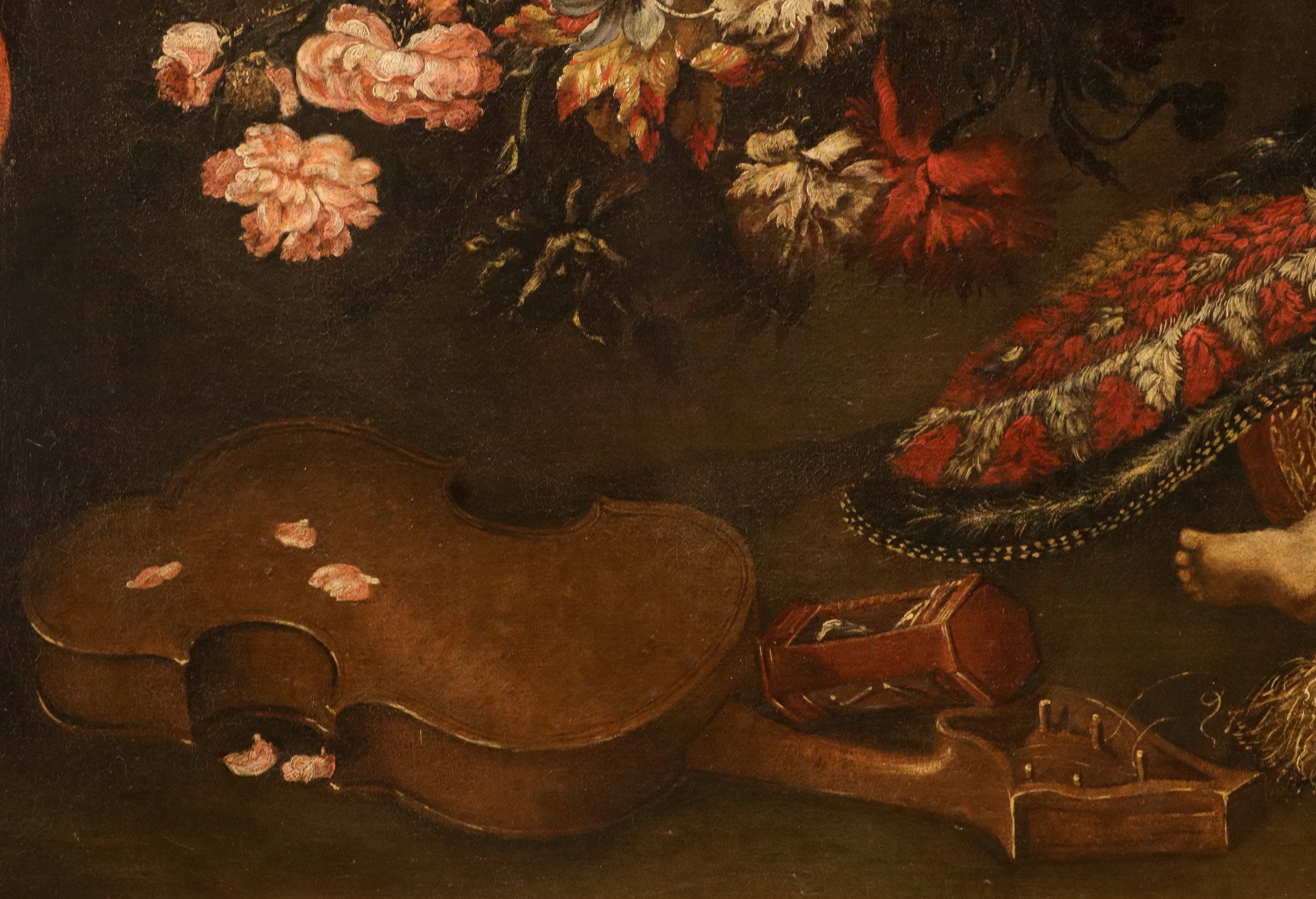
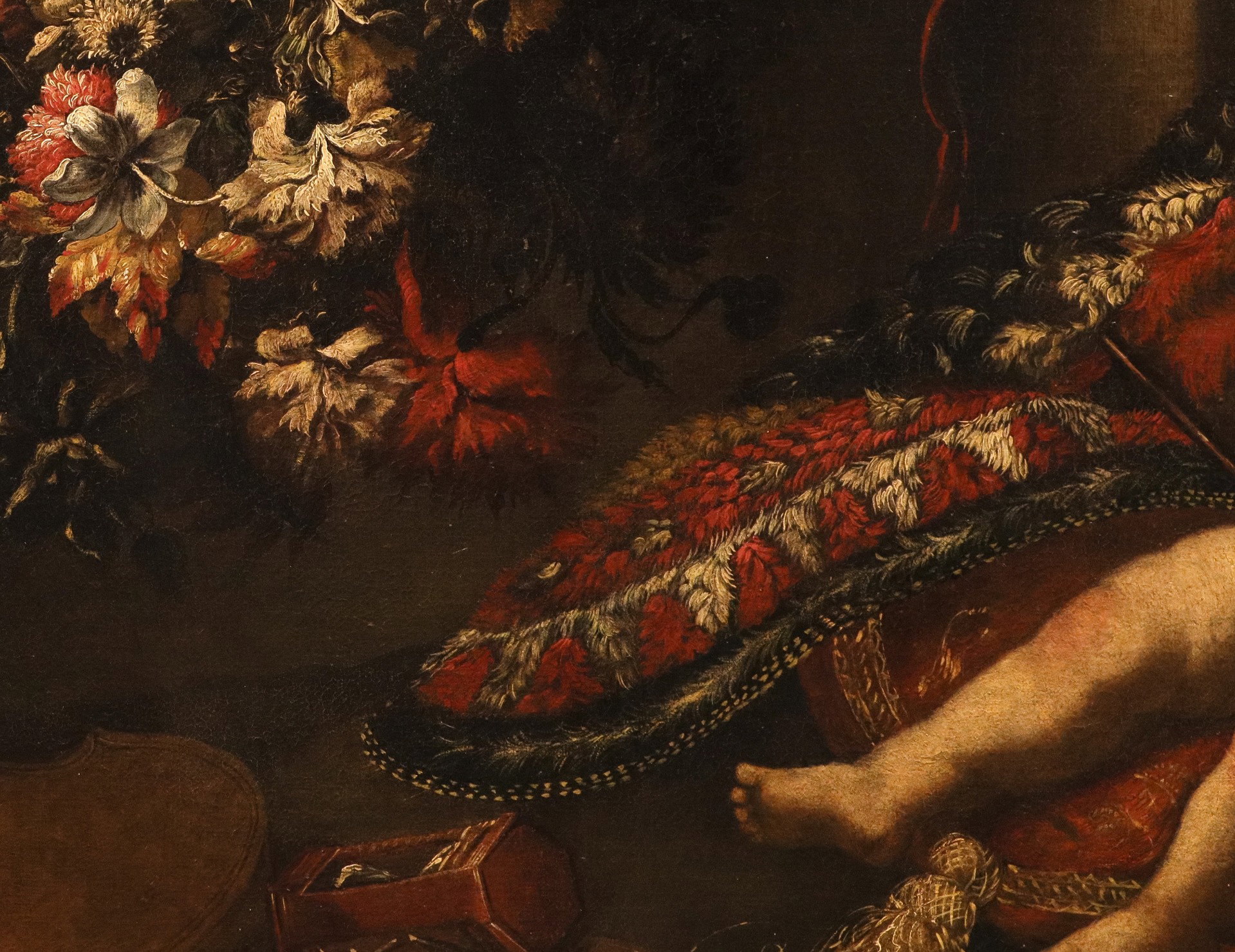
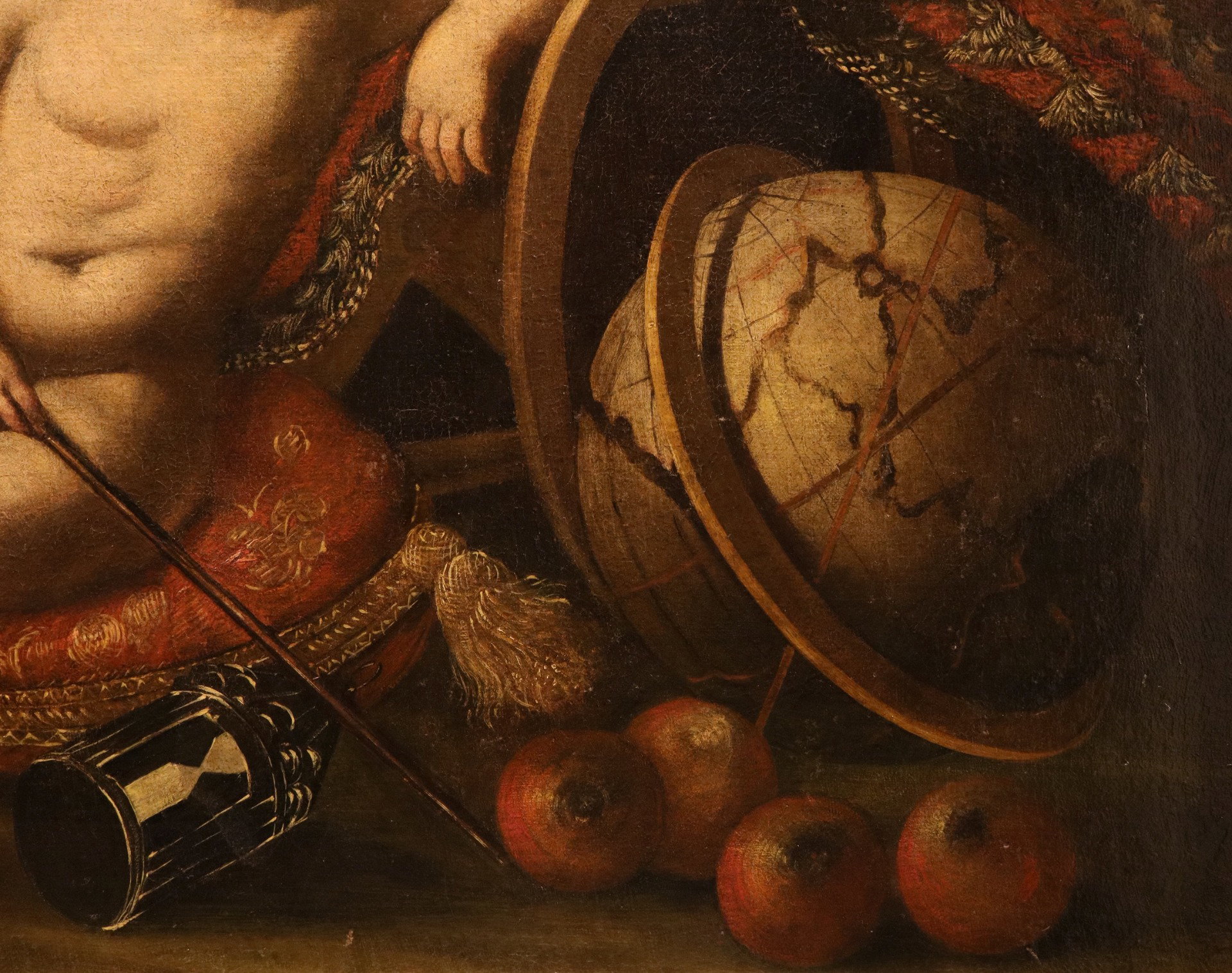
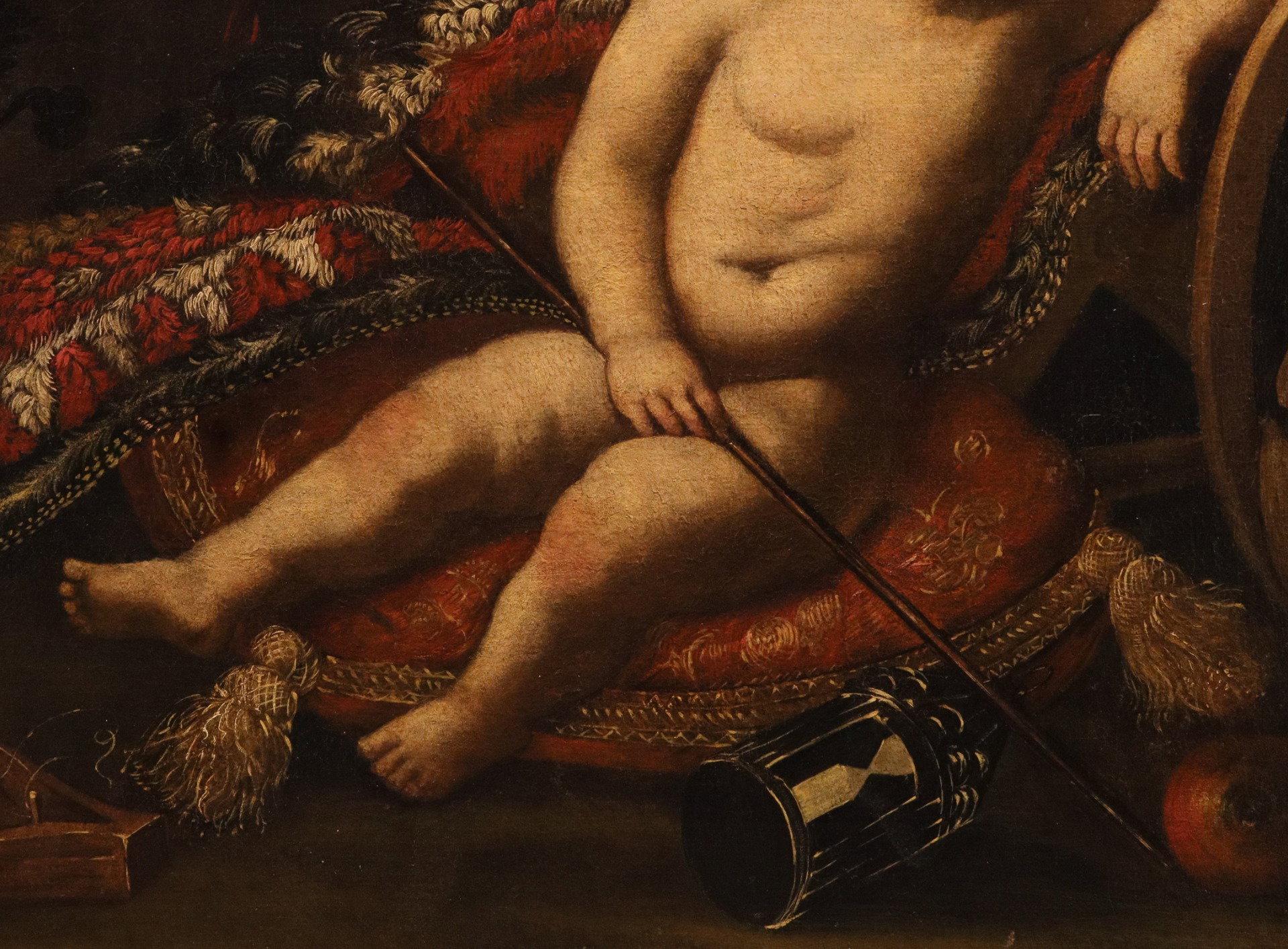
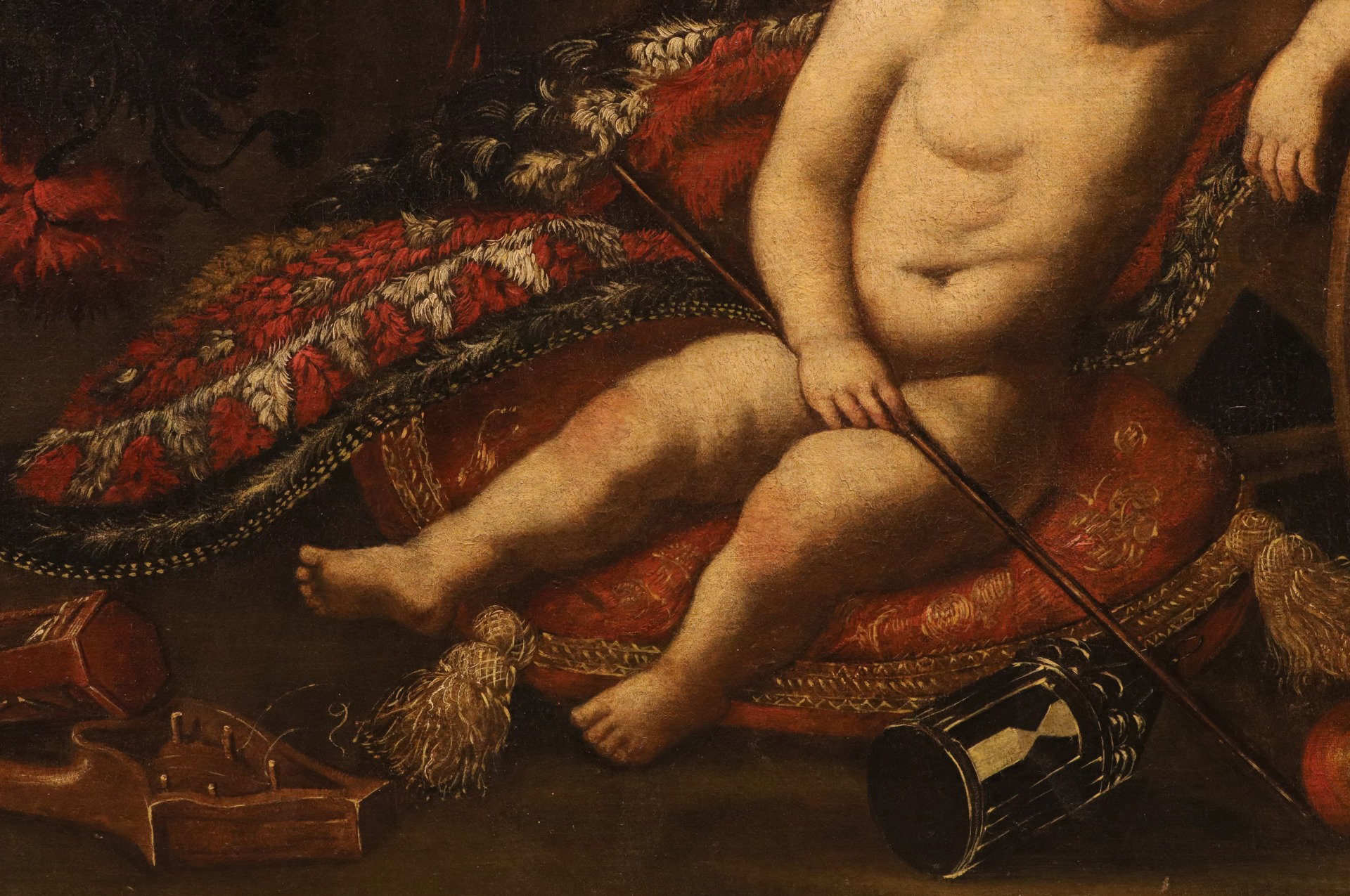
Vanitas with a sleeping putto on a carpet, flowers, violin, globe, hourglasses, and pomegranates
circle of Antonio Tibaldi (Rome, c. 1635 - after 1675)
Oil on canvas (70 x 150 cm. - Framed 82 x 162 cm.)
Full details (click HERE)
The subject of the work offered here is fascinating and rich in allegorical meanings, whispering the fragility of life through the contrast between the sweetness of childhood and the rigor of the objects surrounding it.
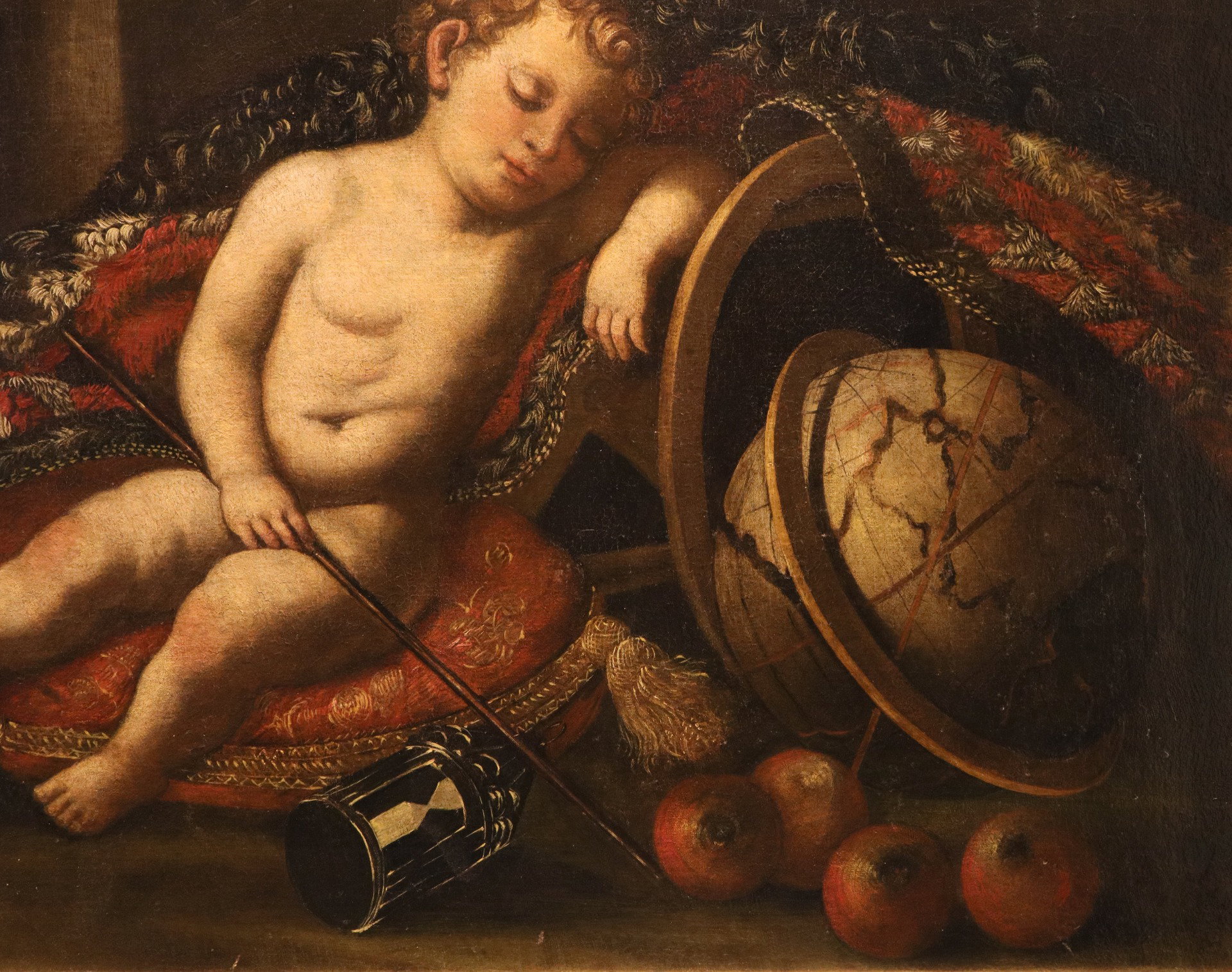
At the center of the scene, a small sleeping child—a cupid or perhaps an allegory of childhood—rests deeply: he is the image of absolute peace, unaware of the passage of time, yet surrounded by symbols that recall its fleeting nature.
The painting is therefore a triumph of details that compose a refined "Vanitas," a term indicating a genre of still life, widespread mainly in the Baroque period, which symbolizes the transience of earthly pleasures, inviting the viewer to contemplate the inexorable passage of time.
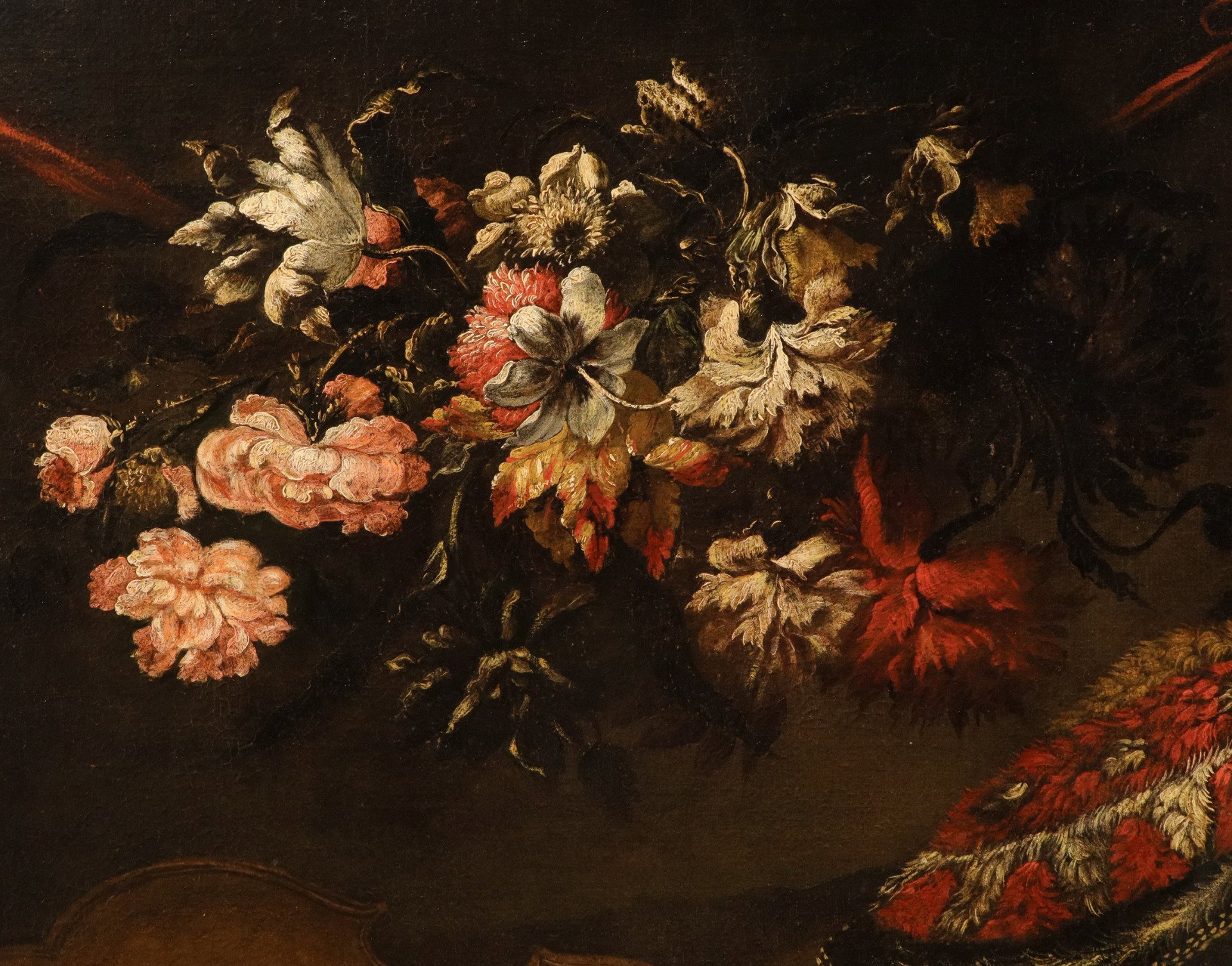
While the child dreams, the world around him tells of the beauty and brevity of existence, and thus the violin and the lush bouquet of flowers represent the pleasures of the senses: the melody that vanishes as soon as it is played and the petals that wilt. This continues with the large terrestrial globe and the two hourglasses, alluding to the vastness of the world and the smallness of man in the face of time, while the ripe fruits, here pomegranates, recall the transience of life and its riches.
The atmosphere is intimate, almost twilight, with light caressing the child's golden curls and making the gold threads of the cushions shine, leaving the background in deep, mysterious shadow. This play of contrasts not only creates depth but imbues each object with an almost theatrical tension.
Given the compositional type and formal choices, our canvas is likely to be attributed to the Roman environment of the 17th century, specifically to an artist close to the painter Antonio Tibaldi (Rome, c. 1635 - documented until 1675), a skilled still-life painter who was an epigone of Francesco Fieravino, known as Il Maltese, and therefore an appreciated painter of still lifes similar to those of his master.
Tibaldi worked predominantly in Rome, where his presence and notoriety are evidenced by the numerous compositions attributed to him in recent times. In these, he adapted the pictorial mastery of Il Maltese with his own personal, delicate, and captivating creativity; these canvases, very similar to ours, were kept in the most important public and private collections, such as those of the Albani, Barberini, Chigi, and Colonna families.
It is also true that the works of the Roman master influenced the training of numerous still-life painters both in Italy and in Europe; thus, the importance that Tibaldi had as a link between Italian still life and those of Northern European countries is becoming increasingly clear.
ADDITIONAL INFORMATION:
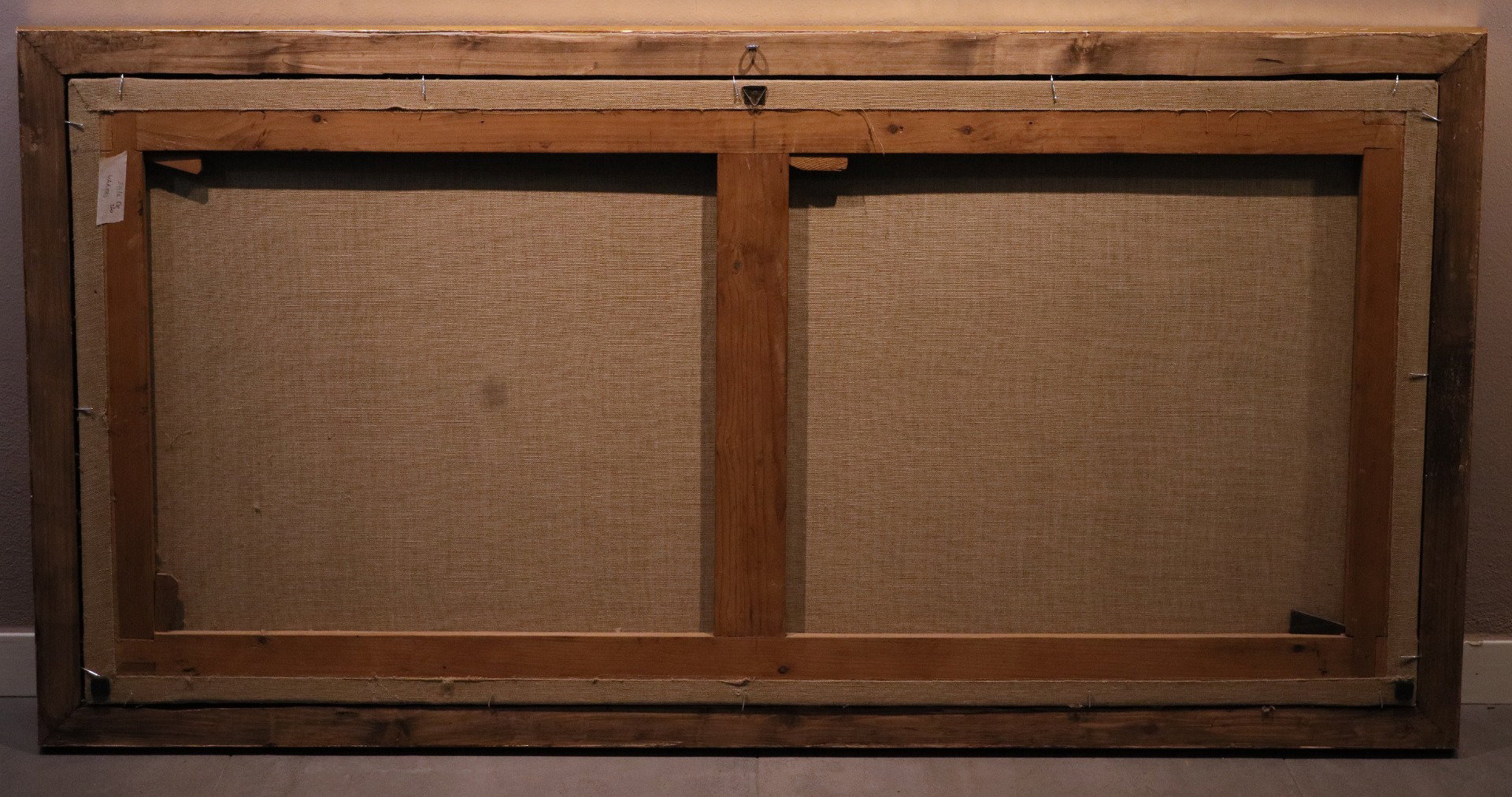
The painting is sold with a pleasant wooden frame and is accompanied by a certificate of authenticity and a descriptive iconographic sheet.
We handle and organize the transport of purchased works, both within Italy and abroad, through professional and insured carriers.
Contact us for any information, we will be happy to answer you.
Follow us also on:
https://www.instagram.com/galleriacastelbarco/?hl=it
https://www.facebook.com/galleriacastelbarco/