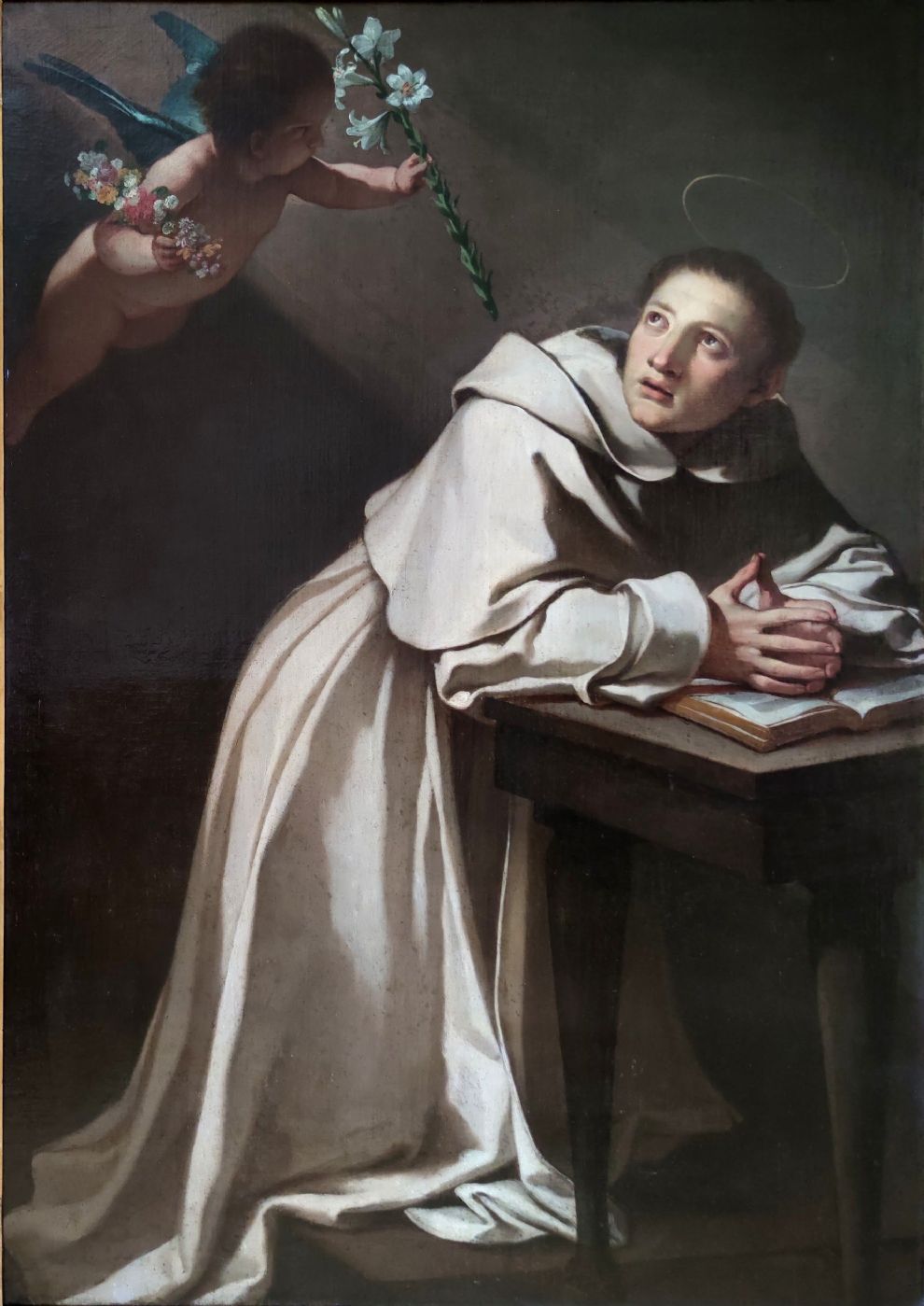
Saint Bruno visited by an angel Within an environment not well defined - which only the bare table seen in profile, with its surface squared by the shaft of light from the left, allows us to recognize as a cell - we see a very young, beardless monk with moist eyes. Kneeling to pray, with one hand resting on the other over an open breviary, is the German Saint Bruno (or Brunone), founder of the contemplative Carthusians. Dressed in the colors of the order, he has just been distracted from his prayers, turning with a spasm of emotion towards the angel who, with light blue wings spread, offers him signs and symbols of ecstasy. A young man, a table with a book, and an angel. Not even the great Zurbarán, when treating the same subject in a painting dating from 1637-39, now at the Spanish Museum of Cadiz, which we must consider a prototype and model for late 17th-century iconography of Saint Bruno, had chosen to be so synthetic and focused (between visible and hidden, his angels would be at least a dozen; while the saint stands, full figure, against a landscape background). Our painting is entirely different, where nothing can disturb or detract from the correctness of a composition that never falters but which, in reality, is a feigned simplicity. The off-center framing is striking, emphasized by the theatrical flourish of the Carthusian habit, rich in chiaroscuro, occupying a large part of the painting, and even extending into the viewer's real space. This authentic symphony in black and white is counterpointed by the light and rosy tones of the young man's skin, as well as, naturally, by the two splendid floral inserts (not to mention the bare table, which the painter renders with such meticulousness that it immediately promotes it to another character). We could continue by highlighting, one by one, the cast shadows and the delicate touches on the saint's fingers... Yet, it takes no more to point out how this perfectly balanced painting, likely from the southern region, belongs to a master of the absolute highest level. A puristic apex of Solimena A slow analysis of the forms compels us to invoke the maturity of Francesco Solimena, the greatest and most decisive of the masters of the Bourbon era, but who matured in the Spanish Naples of Luca Giordano (1634-1705) and Mattia Preti, who died in 1699; if the style is any indication, the painting, which appears to have been executed in the late 1720s, is a coherent 18th-century example of someone who had mastered the resources of a learned, noble, and rapidly disseminated lexicon on the local scene and in the courts of Europe, from Vienna to Paris to the Savoyard Turin. Indeed, this Saint Bruno, in excellent state of preservation, is one of Solimena's most significant and rare autograph works to have re-emerged, alongside the grand fresco mural "The Expulsion of Heliodorus from the Temple," signed and dated 1725, for the counter-facade of the Church of the Gesù Nuovo, the most important Jesuit temple in the Viceroyalty. Other compelling comparisons include Solimena's easel works from the third decade: starting with the celebrated "Saint Gaetan of Thiene" for the church of the same name in Vicenza (among the masterpieces of Neapolitan painting present in mainland Veneto), down to the "Saint Januarius with Angels" from a private collection, which we have also reproduced below. It is the moment of maximum affirmation for the artist who would be responsible for charting the coordinates of the full civilization of the 18th century in Naples, assisted by a highly efficient workshop of young talents (starting with Francesco De Mura, who died on the eve of the French Revolution). With Giordano gone, it falls to Solimena, for whom, incredibly, no monographic exhibition has ever been organized, to show the way; and this can also be understood by looking at our Saint Bruno who, upon closer inspection, walks in perfect balance between different and consequent stylistic worlds: the naturalistic tradition of the 17th century and the grand decorative sweep of the following century. But let us draw closer. Solimena towards Giordano and the 17th Century And let us begin again with the physiognomic identification of the young hermit, to whom the painter invokes and almost demands the viewer's attention, not by chance. The single brushstroke that constructs the lower lip and introduces the touch of white just above it belongs to the lexicon of the best Giordano; the skin tones of the face, the touches of lead white under the eyelids, down to the highlight on the nose where the pigment becomes concrete, even creasing and clumping, also allude to the school of virtuosos of touch (from Ribera to Cavallino to Guarino). Giordano is always present: as is clear if we focus on this detail rendered with a quick, direct brushstroke. The detail of the face that we have shaped from the rest is worth a thousand words. This spectacle of pure painting is a tribute to Giordano and a farewell at the same time. Tribute: if, in the swift, direct brushwork, executed without hesitation, emerges the hand of someone who had meditated on that mastery. Farewell: if Solimena attempts to solidify the painting of the elder, redefining and re-compacting the brushstrokes into closed areas. The 17th Century Tradition In some way, one witnesses here a revival of older stylistic elements, as if, during the full Austrian viceroyalty, under the wings of the imperial eagle (1707-1734), Solimena were trying to rewrite, in his own way, the codes of the early 17th century; especially, looking at our painting, the most puristic and devotional phase, to be placed in the late 1640s, of Massimo Stanzione and his followers. Of this particular puristic current of the Neapolitan post-Caravaggesque scene, which we have recently well-defined, Solimena technically knew every secret, having restored Stanzione's great copper for the Chapel of the Treasury of San Gennaro. But it is superfluous to add how aware he was, in treating the theme of Saint Bruno, of joining an authoritative and prestigious lineage that begins, precisely, with the complex of the Church and Charterhouse of San Martino on the Vomero hill. The Carthusian monks themselves had entrusted Stanzione with the execution of that Carthusian manifesto with multiple figures, well-known to Solimena, "Saint Bruno Giving the Rule," in the late 1730s. As the French say: to jump better, one must take a step back. And no one knew this better than Solimena.