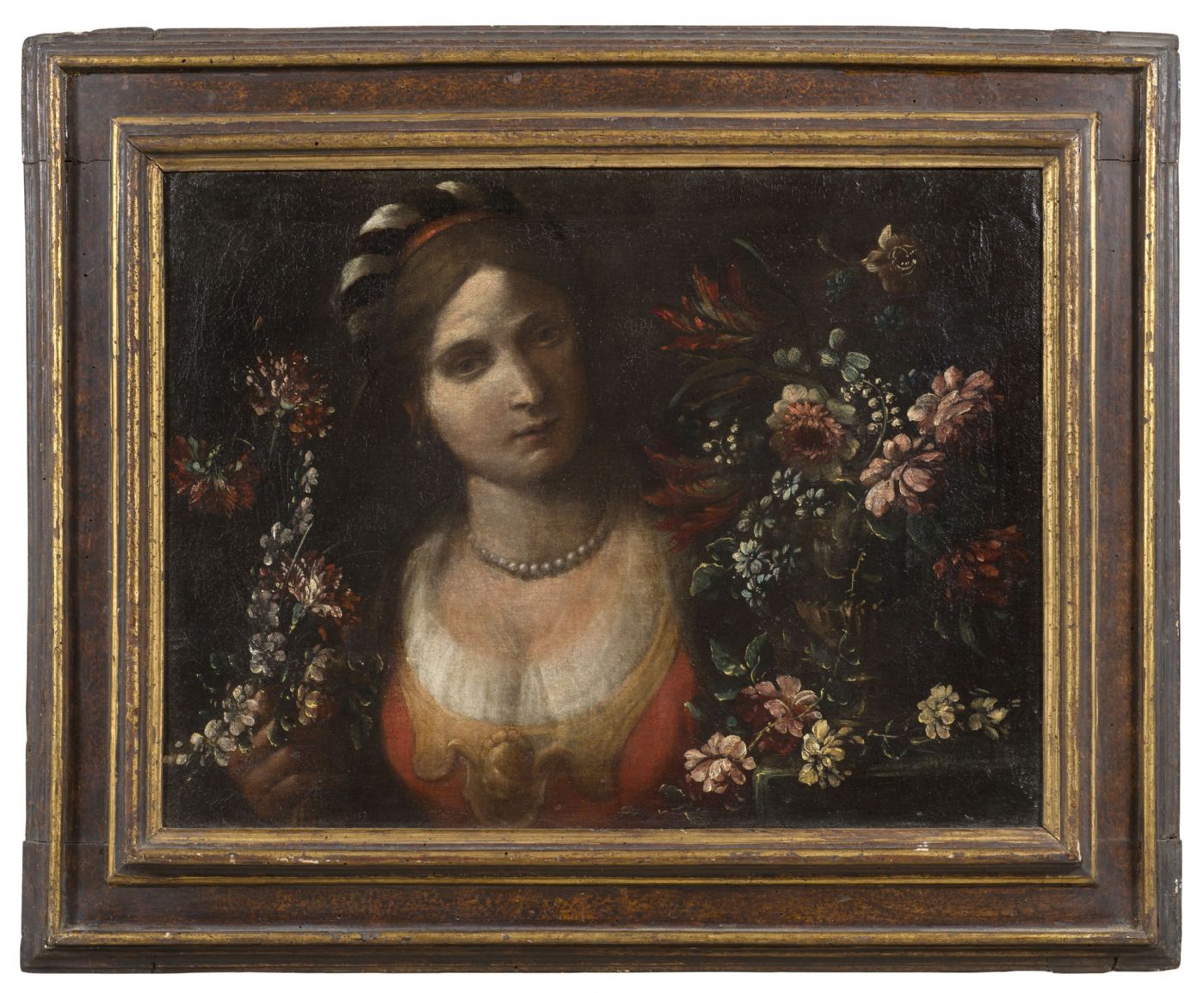
PIETRO PAOLINI
(Lucca, 1603 - 1681)
Young female figure as Flora
Canvas, cm 50 x 68
Within a contemporary frame
Report by Prof. Sandro Bellesi
The work, in fair condition, illustrates, within a very dark and seemingly impenetrable indefinite space, the figure of an attractive young woman, depicted, slightly more than half-length, with some flowers held in her right hand, near a small stone shelf on which a metal vase overflowing with various types of flowers is carefully placed, especially roses, double anemones, fringed tulips, and lilies of the valley. Almost certainly taken from a portrait from life only partially idealized, the painting presents a woman, close to marriage as suggested by the pearl ornament traditionally associated with young betrothed women as a symbol of virginity, dressed as Flora, as indicated by the abundance of flowers, attributes of fertility, perfectly suited to the depiction of a future mother. The comparison of young women close to marriage with Flora, a classical deity associated with spring and the regeneration of the earth, was very frequent in European painting, especially in the seventeenth and eighteenth centuries, in relation to paintings executed, above all, in anticipation of weddings.
Based on the descriptive characteristics of the figure and the stylistic data, it is possible to relate the canvas to the catalog of Pietro Paolini, a seventeenth-century painter of undoubted historical and artistic interest, author of many works, often executed with the help of his most talented collaborators.
A leading figure among the most acclaimed of seventeenth-century Tuscan painting, Paolini, born in Lucca in 1603, moved to Rome at a young age, where, according to ancient sources, he was introduced to the study of the figurative arts in the school of Angelo Caroselli. Through the teaching of this master, the young artist was directed towards painting linked to the ambit of the manfrediana methodus, which, heir to the teachings of Caravaggio and his most faithful followers, favored him, above all, the deepening of studies on the effects of chiaroscuro and on the strongly realistic interpretation of the themes treated. Returning to Lucca in 1629 or shortly after, Paolini began within a short time an intense autonomous activity, which led him to hold a prominent position among local painters of his time. An appreciated author of church paintings and canvases intended for private collections, the artist, to fulfill the numerous commissions, often availed himself, over the years, of the assistance of his closest collaborators, some of whom, today largely unknown, passed on his style until the end of the century. After years of professional success, witnessed by critics and numerous allocations, Pietro Paolini died at an old age in his native city in 1681 (for the artist, see especially P. Giusti Maccari, Pietro Paolini pittore lucchese, Lucca, 1987).
Like most of Paolini's works known today, the author of paintings of greater or lesser executive commitment, even in the case of the canvas in question it is not easy to delimit, at the current state of historical and documentary knowledge, the time of its realization. The almost total lack of typological and lexical changes, for over fifty years of activity, does not allow, in fact, to be able to affirm, with absolute certainty, whether the work can refer to the initial, mature or late catalog of the painter, even if the descriptive characteristics of the dress and hairstyle of the woman would seem to refer to the first decades of the seventeenth century, more precisely to the twenties or thirties.
Deferential to the post-Caravaggesque experiences based mainly on the contrasting effects of light and shadows, with enveloping chiaroscuro in "night light", the figure present in the painting finds adequate comparisons in various works by Pietro Paolini, among which deserve to be mentioned, for greater physiognomic and lexical pertinence, the Two Musicians formerly at Weinmüller in Munich of Bavaria (A. Ottani, Per un caravaggesco toscano: Pietro Paolini (1603-1681) in “Arte Antica e Moderna”, 21, 1963, p. 35), the Young Page currently of unknown location (P. Giusti Maccari, op. cit., pp. 130-131 n. 47) and, again, the Madonna with Child Jesus and Saint Rosalia in the parish church of Tereglio (P. Giusti Maccari, op. cit., pp. 142-144 n. 64). With the main figures present in these works, in particular the altarpiece of Tereglio documented to 1632, the canvas finds adequate matches, especially in the definition of the face, defined with elongated and perfectly regular features, in the smoothness of the flesh caressed by soft and enveloping lights and in the care of the hairstyle, divided in the center of the forehead, adorned with a circular headdress.