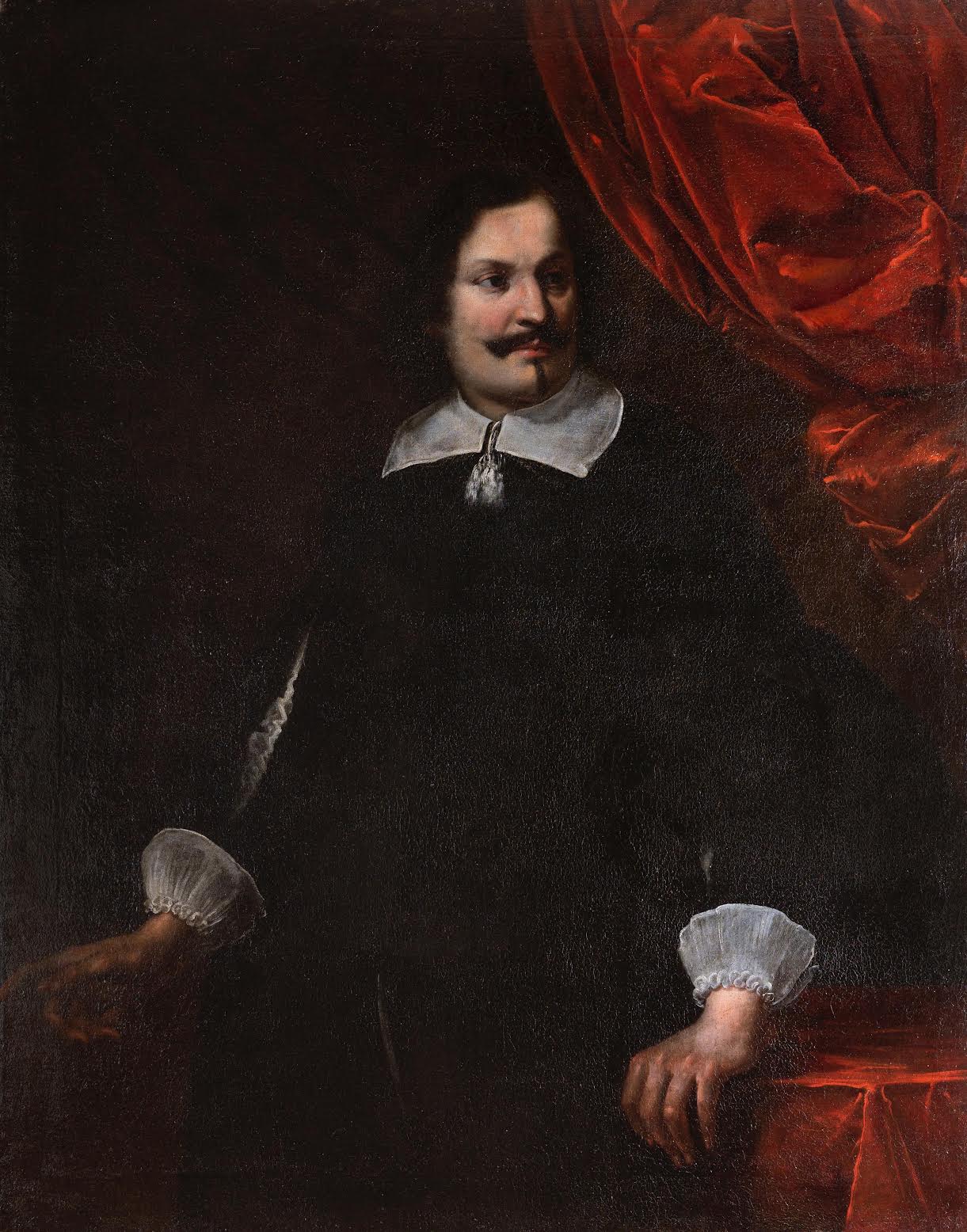
Giovanni Bernardo Carbone
(Genoa 1616 - 1683)
Portrait of a Gentleman, before 1658
Oil on canvas, 122x97 cm
Description by Giacomo Montanari
The painting portrays an unidentifiable aristocrat, captured by the painter while turning his head and gaze to his left, as if distracted by the - sudden - entrance of the observer into the posing room. From the dark background emerge, forcefully, the red drape of Van Dyckian memory that occupies the right portion of the painting and the gleaming tablecloth spread on the small table on the same side. The left hand of the depicted subject rests on this latter object, while the right hand - caught mid-air - still seems animated by the fervor of a speech or by a “posing” of oratory style, just abandoned. The garment shows refined split sleeves, with white cuffs and collar, closed at the neck by a tassel that hangs on the chest. The face, which seems to depict a man no older than thirty, has a florid and ruddy complexion, emphasized by full, well-defined lips of an intense red and closed in a serious and impassive expression. The anonymous subject - under an important nose - sports a pair of substantial mustaches, echoed on the chin by a carefully groomed mouche, while the large dark eyes seek - outside the space of the painting - the cause of his momentary distraction. The work presents the formal characteristics adopted by Genoese portraiture from the end of the third decade of the seventeenth century, largely derived from the compositional types imposed by the portraiture of Antoon van Dyck (1599-1641, active in Genoa between 1621 and 1627) and practiced by other Flemish artists such as Jan Roos (1591 - 1638) or Jan Hovaert (c. 1615-1665), both of whom died in Genoa and were among the most celebrated portrait painters for the city's aristocracy. However, the work seems to reflect a manner closer to the style of an artist inspired by the Flemish tradition of the first half of the century, but of Genoese formation and descent, such as the very talented portraitist Giovanni Bernardo Carbone (1616-1683), whose figure has been brilliantly reconstructed in the recent monographic work by Daniele Sanguineti? It seems, in fact, that we can recognize autograph features of Carbone in the tormented brushstroke that sketches and illuminates the fabrics, pulling and releasing them with quick and bold highlights, as is evident in the taut tablecloth of the small table and in the soft hanging of the opulent and theatrical drapery. The pictorial matter then becomes a gentle breath in the transparencies of the cuffs, which further emphasize the earthy, fleshy, and vivid presence of the hands, far from diaphanous, but rather animated and present, like the face of the depicted subject. These pictorial characteristics, far from being found only in the Genoese painter's portrait production, also indicate Carbone's artistic activity in paintings of sacred subjects, among which is the "Madonna with Child" of the Musei di Strada Nuova in Genoa (inv. PR 97), where the reds of the Virgin's dress are treated similarly. Similar care in the complexions and in the everyday humanity of lips, hands, and eyes emerges strongly in the precious portrait depicting Lucrezia Pallavicino, probably executed in the year of her marriage to Gio. Giacomo Brignole: a date, 1658, which can constitute the terminus ante quem for chronologically placing the canvas object of this intervention. At the end of the sixth decade, in fact, Carbone appears dramatically autonomous and capable of imbuing personality and independent author's choices in his paintings, while maintaining a never-forgotten predilection for the legacy acquired from references to the work of Van Dyck (see, in the case of the Pallavicino portrait, the playful presence of the Moorish servant, a clear reference to similar compositional and pictorial choices of the Flemish artists mentioned above). At the beginning of this phase, around 1650, we could place the canvas in question, still firmly linked to the compositional style and the executive peculiarities that had so strongly marked the type of portrait in Liguria and - in particular - in Genoa.