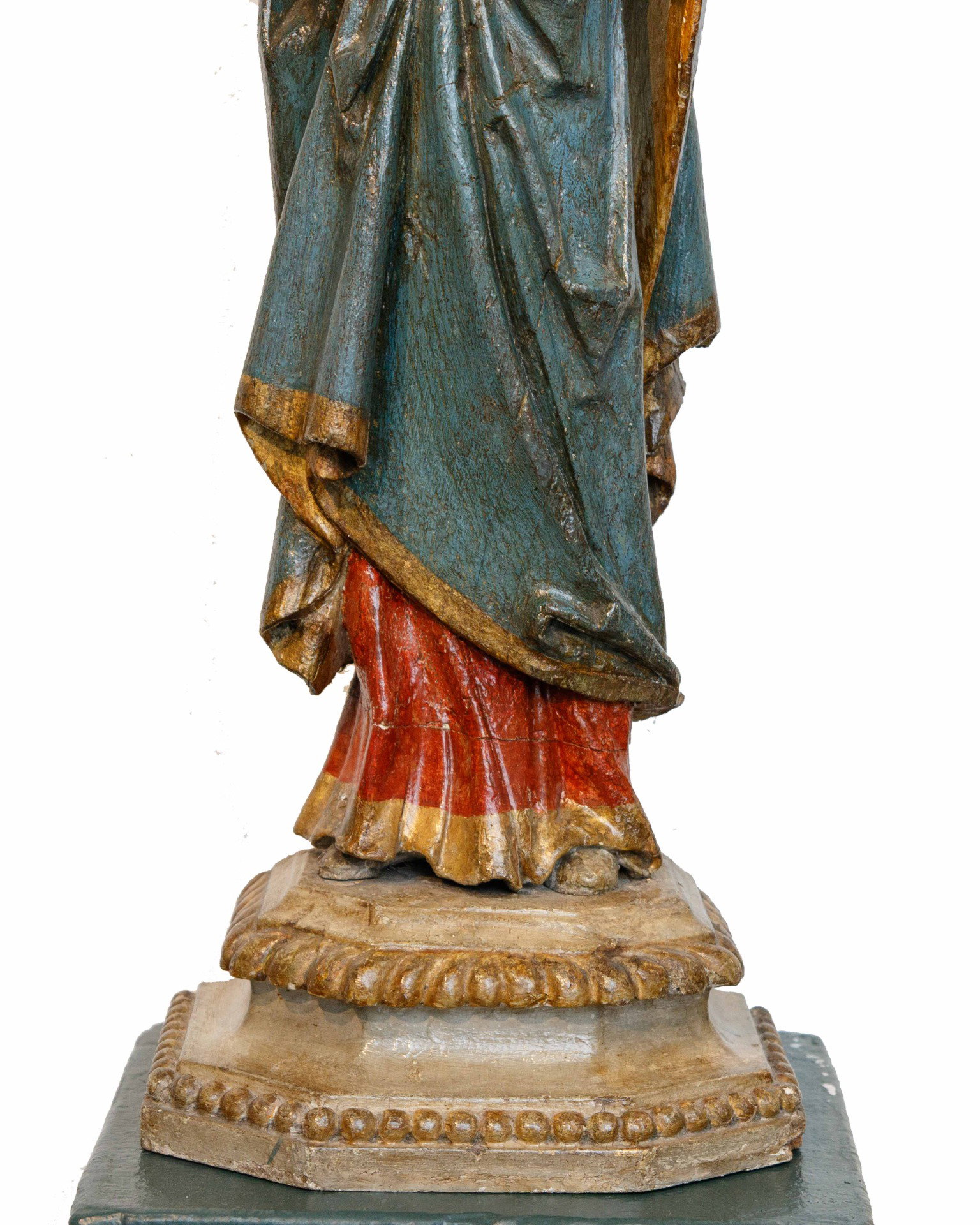
16th century, French school
Madonna with Child
Carved and painted wood, 68 x 23 x 17 cm
This fascinating carved wooden sculpture, attributable to the French school of the 16th century, presents us with a representation of the Virgin with Child, an iconographic theme of profound and lasting resonance in the history of Christian art. The statue stands out for its formal elegance and the delicacy of the details of the original polychromy. The Virgin is depicted in an upright and composed posture, with an aura of majesty and tenderness. Her face expresses a sweet serenity, with soft features and slightly narrowed eyes that seem to contemplate the Child she holds in her arms. Her head is adorned with a rich carved crown, typical of the sculptural representation of Virgins in the French area since the Gothic period, a symbol of her celestial royalty and her role as Queen of Heaven, which adds an element of splendor to the composition. The hairstyle is delicately sculpted and falls to the sides of the face. The Virgin's garments are an element of great interest. The drapery is rendered with mastery, creating deep and fluid folds that give volume and movement to the figure. We can glimpse traces of what must have been a lively polychromy: an internal garment of a warm color, perhaps red or orange, emerges from under a larger cloak, probably of a pastel green-blue or a gray-blue, which envelops her figure. The edges of the garments are embellished with subtle golden decorations, a sign of attention to detail and a desire to ennoble the figure. The Child Jesus is held on the Virgin's left arm, in a natural and affectionate position. He too wears a simple garment that reveals his childish forms. His expression is that of a blessing child or looking towards the observer, establishing a visual connection. His proportions are typical of the representation of the Child of the period, with a certain gravitas that foreshadows his destiny. The statue rests on an elaborate base, which contributes to its stability and enhances its verticality. The base features moldings and probably traces of gilding, indicating that this part was also cared for in detail to elevate the sacred figure.
Overall, this carved wooden Madonna is an absolutely significant example of the skill of French artisans of the 16th century. It combines religious devotion with a remarkable artistic refinement, attesting to the beauty and spirituality that these works were able to evoke in the faithful and art lovers. Despite the passage of centuries, its presence remains powerful, evoking a sense of peace and veneration.